How You Know if the Woman Fits My Personality
Do men and women actually accept different personalities?
(Image credit:
Getty Images
)
Personality profiles appear to reveal consequent (if subtle) differences between men and women – but are they meaningful? Christian Jarrett untangles a knotty and controversial question.
I
It'south been said that men and women are and so unlike each other, it's as if they're from different planets – a claim that continues to charm and irritate. John Gray's original mega-selling book Men are from Mars, Women are from Venus, showtime published in the early 1990s, has sold millions, spawning numerous parodies (such as Katherine Black and Finn Contini'south Women May Be from Venus, But Men are Really from Uranus) and fifty-fifty comedy phase shows, such every bit Men are from Mars, Women are from Venus, Live! currently playing off Broadway.)
While our physical differences in size and beefcake are obvious, the question of psychological differences betwixt the genders is a lot more complicated and controversial. At that place are issues around how to reliably measure the differences. And when psychologists find them, there are normally arguments over whether the causes are innate and biological, or social and cultural. Are men and women born different or does society shape them that way?
These questions are particularly thorny when you consider our differences in personality. Most research suggests that men and women really do differ on some of import traits. Merely are these differences the result of biology or cultural pressures? And just how meaningful are they in the existent world? One possibility is that most differences are tiny in size but that combined they can accept important consequences.
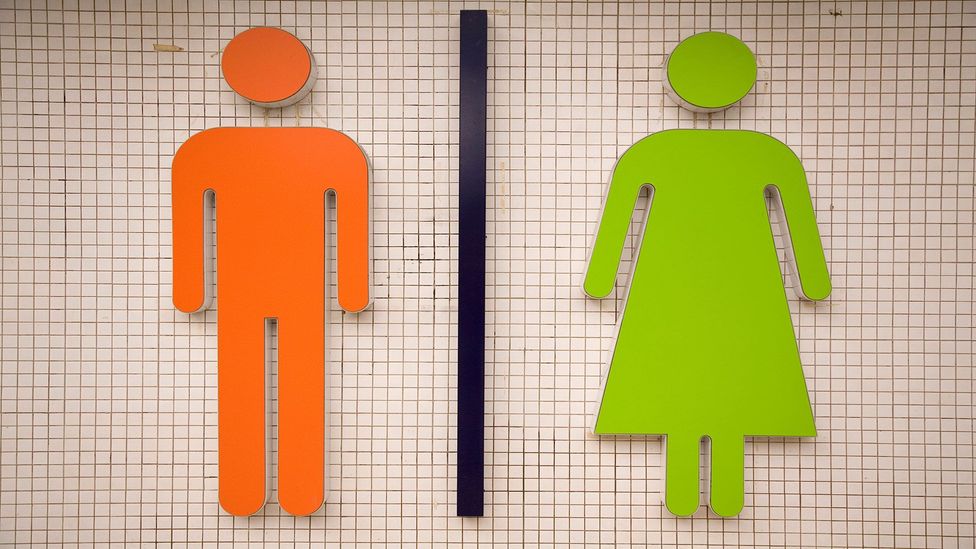
Does our civilization prescribe rigid gender roles? (Credit: Alamy)
One of the most influential studies in the field, published in 2001 by pioneering personality researchers Paul Costa, Robert McCrae and Antonio Terracciano, involved over 23,000 men and women from 26 cultures filling out personality questionnaires. Across these various cultures, including Hong Kong, USA, Bharat and Russian federation, women consistently rated themselves every bit being warmer, friendlier and more anxious and sensitive to their feelings than did the men. The men, meanwhile, consistently rated themselves as being more believing and open to new ideas. In the jargon of personality psychology, the women had scored higher on boilerplate on Agreeableness and Neuroticism and on one facet of Openness to Experience, while the men scored college on one facet of Extraversion and a different facet of Openness to Feel.
Similar results came in 2008 when a separate inquiry team asked more than 17,000 people from 55 cultures, to fill out personality questionnaires. Again, women scored themselves higher on Conjuration and Neuroticism and this fourth dimension as well on Conscientiousness and the warmth and gregariousness facets of Extraversion.
One obvious criticism was that the participants were rating their ain personalities. Perhaps the women and men differed simply because they were describing themselves in the mode their societies expected them to be. But this seems unlikely because another study, led past McCrae and his collaborators, found broadly similar results from 12,000 people from 55 various cultures even though they were asked to rate the personality of a human being or women they knew well, rather than their own personality.
Adding to the picture, other research has shown that the genders brainstorm to differ in personality very early in life. For instance, one study published in 2013 looked at ratings of the temperament of 357 pairs of twins fabricated when they were iii-years-quondam. The boys were rated as more active, on boilerplate, than the girls, while the girls were rated as more than shy and as having more control over their attention and behaviour.

Consistent differences between boys and girls appear to emerge at an early historic period (Credit: Alamy)
And gender differences in personality seem to persist into the twilight years. Another study looked at average differences in personality between women and men aged 65 to 98, and just as with enquiry on younger adults, the elderly women tended to score college on Neuroticism and Agreeableness than the elderly men.
These findings brand sense to evolutionary psychologists who say that our psychological traits today reflect the event of survival demands experienced past our distant ancestors, and farther, that these demands were dissimilar for men and women. For example, women with more nurturing personalities would accept been more likely to succeed in raising vulnerable offspring, while men with bolder personalities would accept been more successful in competing for mates. In plow, these traits would take been passed down to successive generations.
Some scholars and commentators are uncomfortable with such a biological account of human behaviour, even so, which they experience underestimates the influence of the social and cultural forces that shape who we are and how we behave.
Information technology's most certainly true that these social forces play a part. Only all three large, cross-cultural studies by Costa, McCrae and others actually found men and women differed in boilerplate personality more than in more developed and gender-egalitarian cultures, such as in Europe and America than in cultures in Asia and Africa where in that location is less gender equality (as measured by such things as women's literacy and life expectancy).
This seems to run confronting the idea that our personalities develop from cultural expectations effectually traditional gender roles. Ane caption for this surprise finding is that the innate, biological factors that cause personality differences between men and women are more than dominant in cultures where the genders are more equal. Such a scenario would certainly fit with what we know about the relative influence of genes and the environment on other psychological traits – for example, the more that schooling is fabricated equal for everyone, the bigger the influence of inherited intelligence on academic outcomes.
Differences between genders appear fifty-fifty during implicit tests, suggesting we exercise not consciously decide to conform to certain stereotypes (Credit: Alamy)
Another way to look at this event is to apply an implicit measure out of personality. This involves using speed of keyboard responses (pressing different keyboard keys equally fast every bit possible in response to different words) to test how readily people acquaintance words pertaining to themselves with those describing unlike personality traits. The idea is that participants don't realise they are revealing what they recollect well-nigh their personality and then their scores can't be affected by attempts to conform to cultural expectations around gender.
A enquiry squad led past Michelangelo Vianello at the University of Padua in Italy used this arroyo in 2013 with a written report involving over 14,000 people surveyed via the Project Implicit website. Gender differences in personality were 3 times smaller using the implicit measure as compared with a standard personality questionnaire, suggesting the differences uncovered by standard questionnaires are influenced by conscious biases.
And yet, while macerated, the implicit measure out even so revealed statistically significant differences in average personality between men and women, specially in relation to women scoring higher on Neuroticism and Agreeableness. In short, this outcome suggests that gender differences in personality are there at a subconscious level, but studies which relied on self-reporting may have overstated differences in gender, perhaps in part considering people wanted to fit in with cultural expectations.
The debate nigh the size of gender differences in personality doesn't end there. While most large studies have tended to find the most consistent gender differences in the main traits of Neuroticism and Agreeableness, other scholars accept pointed out there could exist more extensive differences if only ane were to look in more detail.
Yanna Weisberg at Linfield Higher and her colleagues tested this possibility in 2011 by measuring what they called the two personality "aspects" for each of the Big Five traits (Extraversion, Neuroticism etc) in over ii,500 people. Extraversion, for example, comprises ii aspects: enthusiasm and assertiveness, while Neuroticisms comprises volatility and withdrawal.
Women tend to score college on measures of politeness (Credit: Alamy)
Taking this arroyo, the researchers actually found gender differences for every one of the 10 aspects of personality that they looked at – women scored higher, on boilerplate, on enthusiasm, compassion, politeness, orderliness, volatility, withdrawal, and openness, while men scored higher on assertiveness, industriousness and intellect. The researchers said that these would not have shown up in studies at the level of the Large Five traits, as used in most before enquiry.
Just Weisberg and her colleagues besides cautioned that, while wide-ranging in terms of the number of characteristics, the gender differences they constitute were only "small to moderate". This is consistent with the size of the gender differences uncovered by McCrae and others in their big cantankerous-cultural studies, which also tended to exist quite subtle. We hear a lot from popular psychologists and cultural commentators nearly men and women being similar different species. In contrast, Weisberg and her squad ended that while gender differences in personality "might be of import in shaping human experience and human culture, they are probably non and then large as to forbid effective communication between men and women".
Marco Del Giudice's inquiry team from the University of Turin disagree. In 2012 they published a paper in which they claimed previous enquiry had underestimated gender differences in personality by taking the average of all trait differences rather than viewing them cumulatively. In an e-mail, Del Giudice explained his approach to me with an illustration. "Gender differences in personality are very much like gender differences in facial appearance," he said. "Each individual trait (olfactory organ length, eye size, etc) shows small differences between men and women, but in one case you put them all together... differences go clear and yous can distinguish between male and female faces with more than than 95% accuracy."
By using this approach to study samples of over 10,000 men and women, Del Giudice and his colleagues documented gender-based differences in personality which they said were "extremely big by psychological standards". They added that they believed their arroyo "made it articulate that the true extent of sex differences in personality has been consistently underestimated".
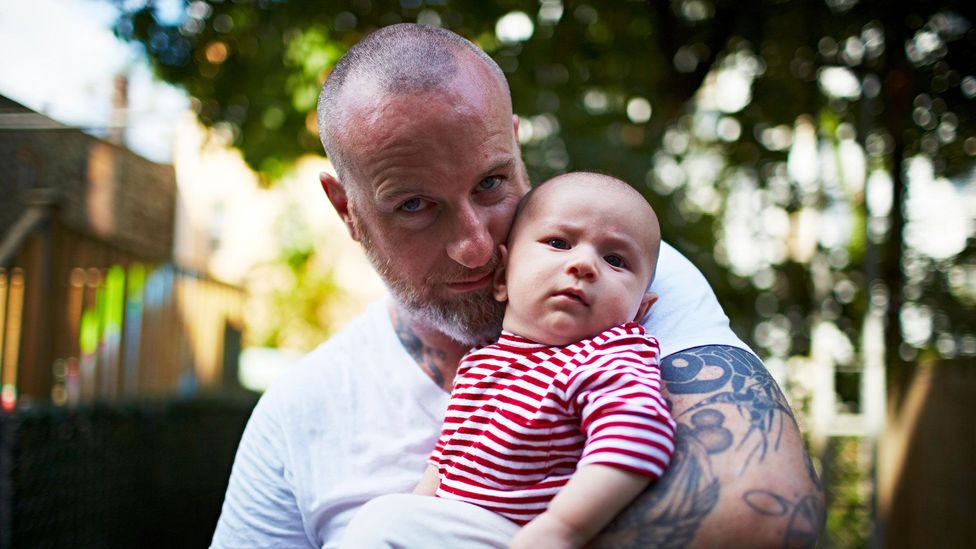
Even when you business relationship for the variation, many psychologists argue that men and women are more similar than unlike (Credit: Alamy)
What should we make of this bold claim? On his web log, statistician Andrew Gelman says that if yous put aside the issues of interpreting the meaning of whatever observed differences between genders, and so "their analysis seems like a adept thought to me". He added: "If you option the dimensions in which men and women differ the about, you can find a big separation". Other experts are less convinced. Janet Hyde – known for her piece of work emphasising the similarities between men and women – says that Del Giudice and his colleagues had simply used a methodology designed to maximise differences and that the results were "uninterpretable".
While the debates nearly the size and causes of gender differences in personality are probable to rumble on for many more than years, it seems reasonable to conclude that for whatsoever reason, at that place are at least some differences, however big or small, in the personality of the average man and woman. But that word "boilerplate" is important – whichever report nosotros choose to trust, there is plenty of overlap in personality between the genders. And remember that this is about personality, not all aspects of noesis and behaviour. Indeed, based on her review of gender differences across "across multiple psychological domains" Hyde has argued "that men and women are more like than different; the distance between them is more like the distance betwixt North Dakota and S Dakota [than the altitude between planets]".
At the aforementioned time, it's worth noting that there is more than to this result than gossip magazine tittle-tattle. There is increasing recognition of the part played by our personality traits in influencing our life choices and mental wellbeing. A amend agreement of how men and women differ in personality, and why, could help create equal opportunity for all, likewise as more than effectively combat mental health issues, many of which bear on one gender more than the other – like levels of low being higher among women, consistent with their scoring higher on average in neuroticism.
As Marco Del Giudice says, "researchers often stress the run a risk of overestimating gender differences, but the converse is only every bit true. Pretending that gender differences are smaller than they are deprives people of a very important slice of knowledge about themselves and others."
"For countless generations men have shaped women, women have shaped men, and here nosotros are – the product of this amazing, complicated history. If we understand this, our judgment becomes broader and less superficial, whether we like the mode we are or would like to alter information technology."
--
Dr Christian Jarrett edits the British Psychological Gild's Research Digest blog. His latest book is Bully Myths of the Brain .
Join 700,000+ Futurity fans past liking us on Facebook , or follow us on Twitter , Google+ , LinkedIn and Instagram .
If you liked this story, sign up for the weekly bbc.com features newsletter , chosen "If Y'all Only Read six Things This Week". A handpicked selection of stories from BBC Futurity, Earth, Civilization, Capital, Travel and Autos, delivered to your inbox every Fri.
How You Know if the Woman Fits My Personality
Source: https://www.bbc.com/future/article/20161011-do-men-and-women-really-have-different-personalities

Post a Comment for "How You Know if the Woman Fits My Personality"