You Are Like a Baby Watch This This Guy Is and Basically You're
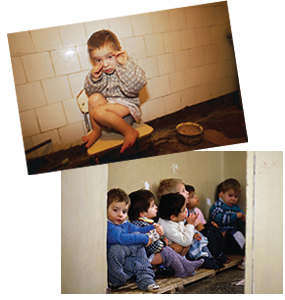 The outset time Nathan Fox, PhD, stepped into a Romanian orphanage, he was struck by the silence. "The most remarkable thing nearly the baby room was how quiet information technology was, probably because the infants had learned that their cries were not responded to," says Fox, who directs the Child Development Laboratory at the University of Maryland.
The babies laid in cribs all twenty-four hours, except when being fed, diapered or bathed on a gear up schedule. They weren't rocked or sung to. Many stared at their own hands, trying to derive whatsoever stimulation they could from the world around them. "Basically these kids were left on their own," Fox says.
Fox, along with colleagues Charles Nelson, PhD, at Harvard Medical School and Children'south Infirmary Boston, and Charles Zeanah, Physician, at Tulane University, take followed those children for xiv years. They describe their Bucharest Early Intervention Project in a new volume, "Romania's Abandoned Children: Impecuniousness, Brain Development, and the Struggle for Recovery" (2014).
Neglect isn't just a Romanian problem, of class. UNICEF estimates that as many as 8 one thousand thousand children are growing upwardly in institutional settings effectually the world. In the The states, neglect is a less obvious — though very real — business. According to a report past the U.South. Department of Health and Homo Services, 676,569 U.Southward. children were reported to have experienced maltreatment in 2011. Of those, more than 78 percentage suffered from fail.
The list of issues that stem from neglect reads similar the index of the DSM: poor impulse control, social withdrawal, bug with coping and regulating emotions, low self-esteem, pathological behaviors such equally tics, tantrums, stealing and self-punishment, poor intellectual functioning and low academic accomplishment. Those are just some of the bug that David A. Wolfe, PhD, a psychologist at the University of Toronto, and his former educatee Kathryn L. Hildyard, PhD, detailed in a 2002 review (Child Corruption & Fail, 2002).
"Beyond the board, these are kids who have severe problems throughout their lifetime," says Wolfe, contempo past editor-in-master of Child Abuse & Neglect.
Now, researchers are beginning to understand some of the ways that early deprivation alters a person's encephalon and beliefs — and whether that damage can be undone.
The Bucharest project
In 1989 Romanian dictator Nicolae Ceauşescu was overthrown, and the world discovered that 170,000 children were beingness raised in Romania's impoverished institutions. Every bit the children'due south plight became public, Fox, Nelson and Zeanah realized they had a unique opportunity to study the furnishings of early institutionalization.
The trio launched their project in 2000 and began by assessing 136 children who had been living in Bucharest's institutions from nascence. Then they randomly assigned one-half of the children to motility into Romanian foster families, whom the researchers recruited and assisted financially. The other half remained in care as usual. The children ranged in age from 6 months to nigh 3 years, with an average age of 22 months.
Over the subsequent months and years, the researchers returned to appraise the development of the children in both settings. They also evaluated a control grouping of local children who had never lived in an institution.
They institute many profound issues amid the children who had been built-in into neglect. Institutionalized children had delays in cognitive function, motor development and language. They showed deficits in socio-emotional behaviors and experienced more psychiatric disorders. They also showed changes in the patterns of electrical activity in their brains, every bit measured by EEG.
For kids who were moved into foster intendance, the motion-picture show was brighter. These children showed improvements in language, IQ and social-emotional operation. They were able to form secure zipper relationships with their caregivers and made dramatic gains in their ability to express emotions.
While foster care produced notable improvements, though, children in foster homes notwithstanding lagged behind the command grouping of children who had never been institutionalized. And some foster children fared much improve than others. Those removed from the institutions before age 2 made the biggest gains. "In that location's a bit of plasticity in the system," Fox says. But to reverse the effects of neglect, he adds, "the earlier, the meliorate."
In fact, when kids were moved into foster care before their second birthdays, past age 8 their brains' electrical activeness looked no different from that of customs controls. The researchers besides used structural MRI to further sympathize the brain differences among the children. They found that institutionalized children had smaller brains, with a lower volume of both gray affair (which is made primarily of the cell bodies of neurons) and white matter (which is mainly the nerve fibers that transmit signals between neurons).
"A history of institutionalization significantly affected brain growth," Fox says.
The institutionalized children who were moved into foster homes recovered some of that missing white matter volume over time. Their grey affair volume, notwithstanding, stayed depression, whether or non they had been moved into stable homes (PNAS, 2012). Those brain changes, the researchers plant, were associated with an increased risk of ADHD symptoms.
Many of the children remain with their foster families. (The researchers no longer support those families financially, but the Romanian government continues to provide stipends for the children'south intendance.) Soon, Trick says, he and his colleagues will begin the 16-twelvemonth cess. They look that to exist especially telling, since the effects of adversity in early childhood tin can re-sally during adolescence.
Regardless of future findings, Play a joke on has seen plenty evidence to describe difficult conclusions. "Children need to be in socially responsive situations. I personally think that there aren't skilful institutions for young children," he says. With millions of children growing upward in like atmospheric condition, he adds, "this is a worldwide public health issue."
Coming to America
In the United States, Megan Gunnar, PhD, director of the Institute of Child Development at the University of Minnesota, has helped fill up in other pieces of the puzzle. In 1999, she and her colleagues launched the International Adoption Project, an extensive test of children adopted from overseas. She at present has nearly 6,000 names on her registry and her research is ongoing.
Gunnar has plant certain encephalon changes are common amidst children who came to the United states from orphanages, including a reduction in brain volume and changes in the development of the prefrontal cortex.
"Fail does a number on the brain. And we see behaviors that follow from that," she says.
She'south establish postal service-institutionalized kids tend to take difficulty with executive functions such as cerebral flexibility, inhibitory control and working retentiveness. They are often delayed in the development of theory of listen, the power to empathise the mental states of others. Many struggle to regulate their emotions. Oft, they suffer from high feet.
One of the nearly common behaviors she sees amidst postal service-institutionalized children is indiscriminate friendliness. "A kid who doesn't know you from Adam will run up, put his arms around you and snuggle in like you're his long-lost aunt," Gunnar says. That friendliness was probably an important coping technique in their socially starved early on lives, she says. "What's interesting is it merely doesn't become away."
Trick and his colleagues had as well noted such disarming friendliness in the Romanaian orphanages. Initially, children with indiscriminate friendliness were thought to have an attachment disorder that prevented them from forming good for you connections with adult caregivers. Merely findings from the Bucharest Project as well every bit Gunnar's own enquiry have demonstrated otherwise, she says.
In a study of 65 toddlers who had been adopted from institutions, Gunnar establish that near attached to their new parents relatively quickly, and past nine months mail service-adoption, 90 percent of the children had formed strong attachments to their adoptive parents. Withal that attachment was often "disorganized," marked past contradictory behaviors (Development and Psychopathology, in press). A child might appear confused in the presence of a caregiver, for instance, sometimes approaching the caregiver for condolement, and other times showing resistance.
"There were things that happened in terms of early development, when they lacked that responsive caregiver, that they're carrying forward," Gunnar says.
One of those things may exist a disrupted cortisol pattern. Cortisol, commonly known as the "stress hormone," typically peaks presently afterwards waking, then drops throughout the day to a low point at bedtime. Merely Gunnar found that children with a history of fail typically have a less marked cortisol rhythm over the course of the day. Those abnormal cortisol patterns were correlated with both stunted physical growth and with indiscriminate friendliness (Evolution and Psychopathology, 2011).
Indiscriminate friendliness may as well be tied to the amygdala. In a report using fMRI, Aviva Olsavsky, Medico, at the University of California, Los Angeles, and colleagues establish that when typical children viewed photos of their mothers versus photos of strangers, the amygdala showed distinctly unlike responses. In children who had been institutionalized, however, the amygdala responded similarly whether the children viewed mothers or strangers. That response was particularly notable amidst kids who exhibited more than friendliness toward strangers (Biological Psychiatry, 2013).
Closer to dwelling house
Other researchers are as well exploring physiological differences in children who have experienced fail. Around the time Gunnar was launching her adoption study, Philip Fisher, PhD, a psychologist and research scientist at the University of Oregon, was working with American foster children. Initially, he suspected the behavioral and developmental difficulties they experienced stemmed from physical abuse. But as he shared data with Gunnar and others, he realized they looked a lot like postal service-institutionalized children.
Though cortisol tends to follow a daily wheel, it likewise spikes during times of stress. Fisher expected that his foster children, who had clearly experienced stressful situations, might evidence high levels, too. Instead, he discovered something quite different. "Their levels were low in the morning and stayed low throughout the day," he says.
Combing through the case records of the children in his sample, he discovered that disregulated cortisol was not associated with physical or sexual abuse, but with early neglect. "This blunted daily pattern with low morning cortisol seemed to be a hallmark of fail," he says. "That was a pretty powerful flick."
In fact, abnormal cortisol cycles take previously been noted in a variety of psychological disorders, Fisher says, including anxiety, mood disorders, beliefs problems and mail-traumatic stress disorder. Simply the proficient news: Cortisol patterns appear to be changeable.
Fisher constitute that foster kids living with more responsive caregivers were more likely to develop more normal cortisol patterns over time. Kids living with caregivers who were stressed out themselves didn't testify that recovery (Psychoneuroendocrinology, 2007). "We're more likely to meet that blunted blueprint when they don't get that support, and there's a lot of stress in the family unit," he says.
Helping caregivers manage their own stress and develop more than positive interactions with their children may help reset the kids' stress responses. Fisher is at present developing and testing video coaching programs that aim to place and reinforce the positive interactions foster parents are already having with their young children. "We can evidence people very precisely the things we know are at the cadre of promoting healthy development," he says.
Meanwhile, he's likewise looking for other physiological systems affected by early adverse experience — specially those that are malleable. "If we can impact those systems, especially without pharmacology, nosotros have great tools we can leverage," he says.
For instance, kids with a history of neglect are known to have problem with executive operation. One mode that presents itself is that the kids don't evidence much brain response to corrective feedback; instead, they oftentimes make the same mistakes over and over. Targeted interventions may help those children learn to tune in to the important cues they're missing, Fisher says. Though more research is needed, he adds, computer-based brain-grooming games and other novel interventions might prove to be useful complements to more traditional therapy.
Despite progress, child neglect remains underfunded and understudied, says Wolfe. Politically, information technology's a prickly subject. "Neglect is non a disease. It'due south entwined with the delivery of proper social and medical services. It's embedded in socioeconomic disadvantage," he says.
Politics bated, science is making strides toward erasing the stamp that early fail leaves on a child. New understanding of the ways that neglect changes a person's physiology is helping to button the field forrad, Wolfe says.
That progress is sorely needed, but the almost of import first step is to remove neglected children to a safety, loving environment, he adds. "The brain will often recover, if it's allowed to."
You Are Like a Baby Watch This This Guy Is and Basically You're
Source: https://www.apa.org/monitor/2014/06/neglect

Post a Comment for "You Are Like a Baby Watch This This Guy Is and Basically You're"